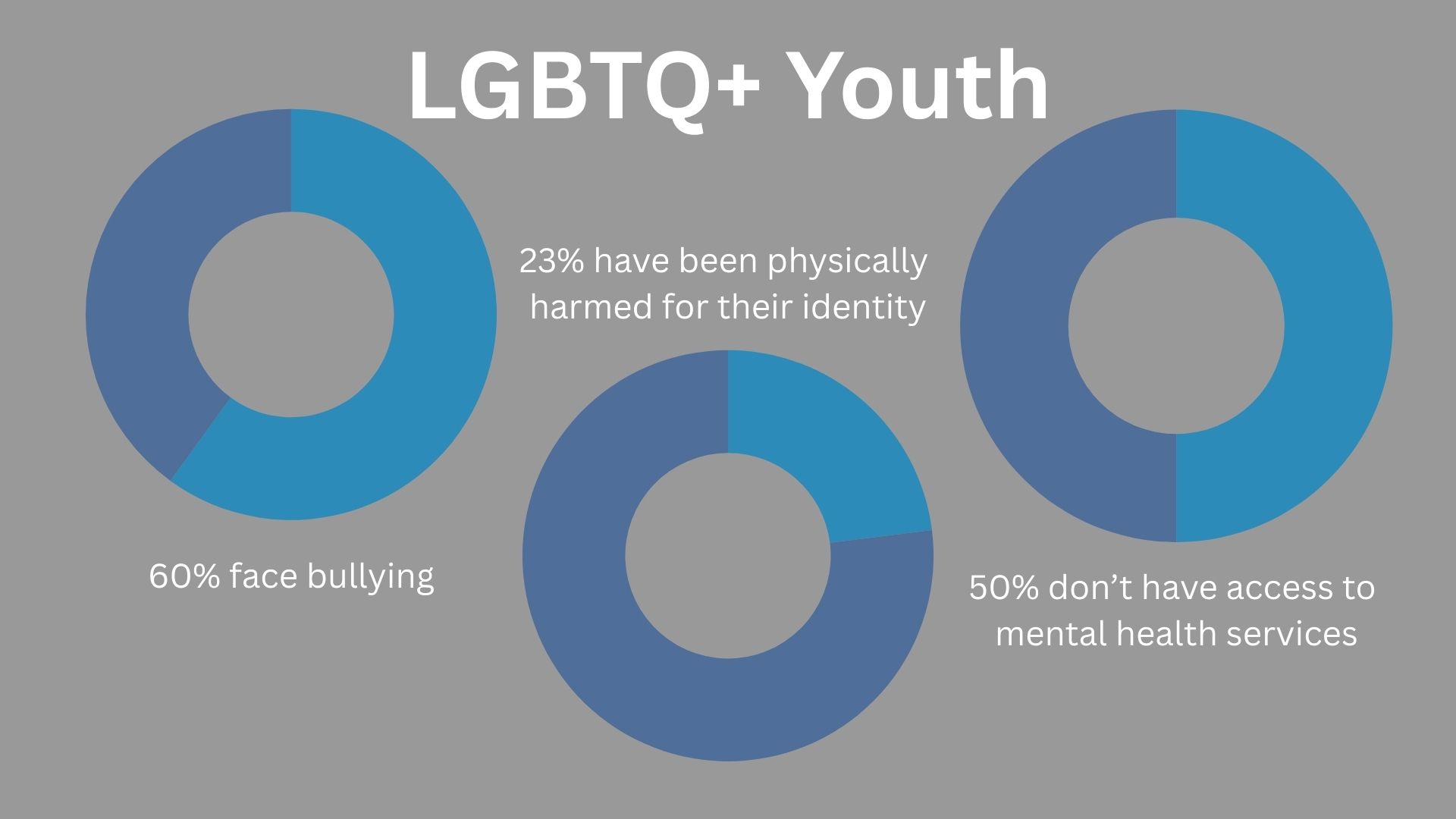
Mental health risk for LGBTQ+ youth (Garey)
Queer representation is in a volatile and contested state in the current political climate, with symbols of pride such as painted crosswalks or flags being targeted nationally. This is happening as LGBTQ+ characters and storylines are becoming more visible, sparking debates over their impact. These social changes and debates directly affect youth, specifically those who are still forming their identities, and are forced to endure many social pressures and stigmas. Protecting queer representation in both digital and physical forms is important to prevent mental health issues in youth who may not understand their identity.
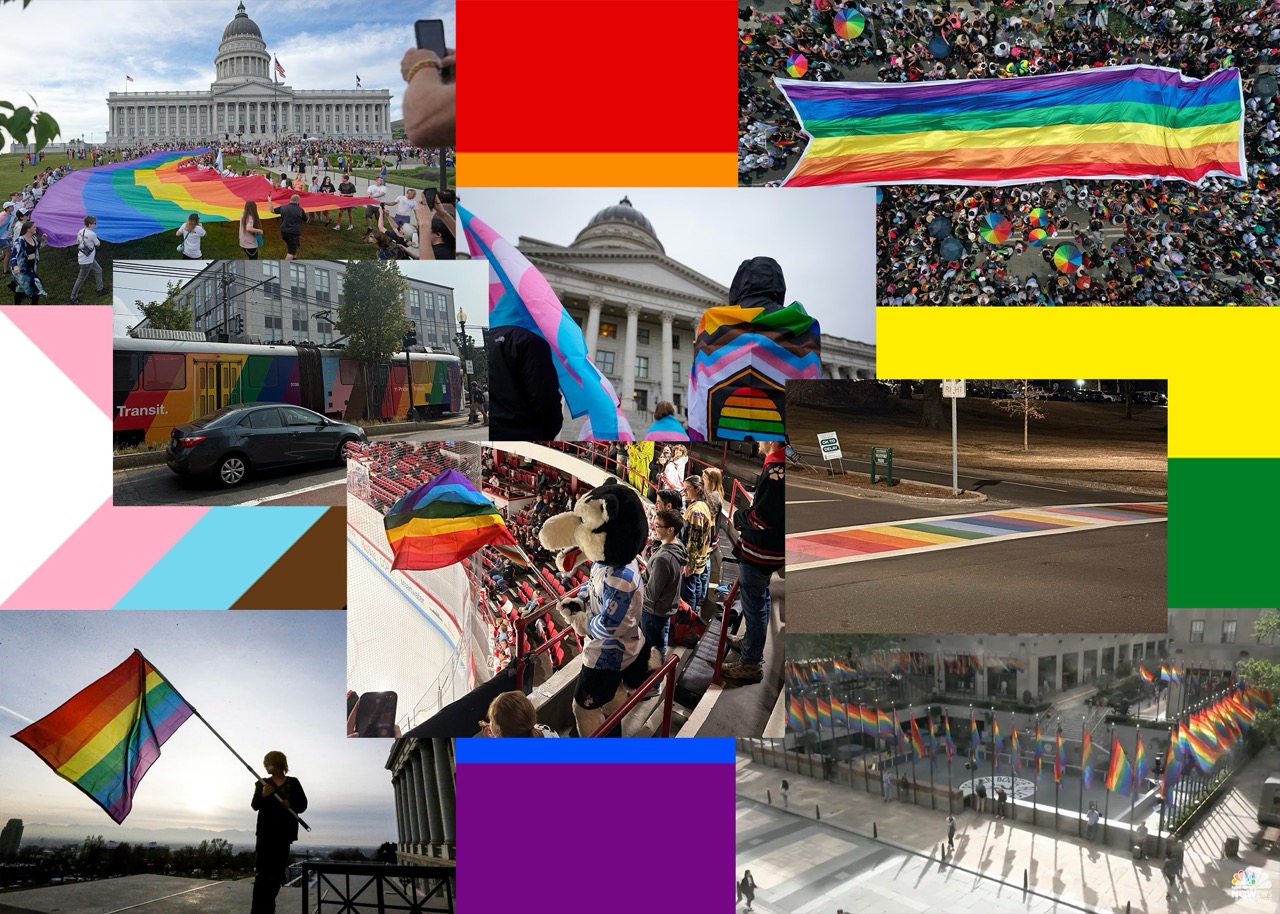
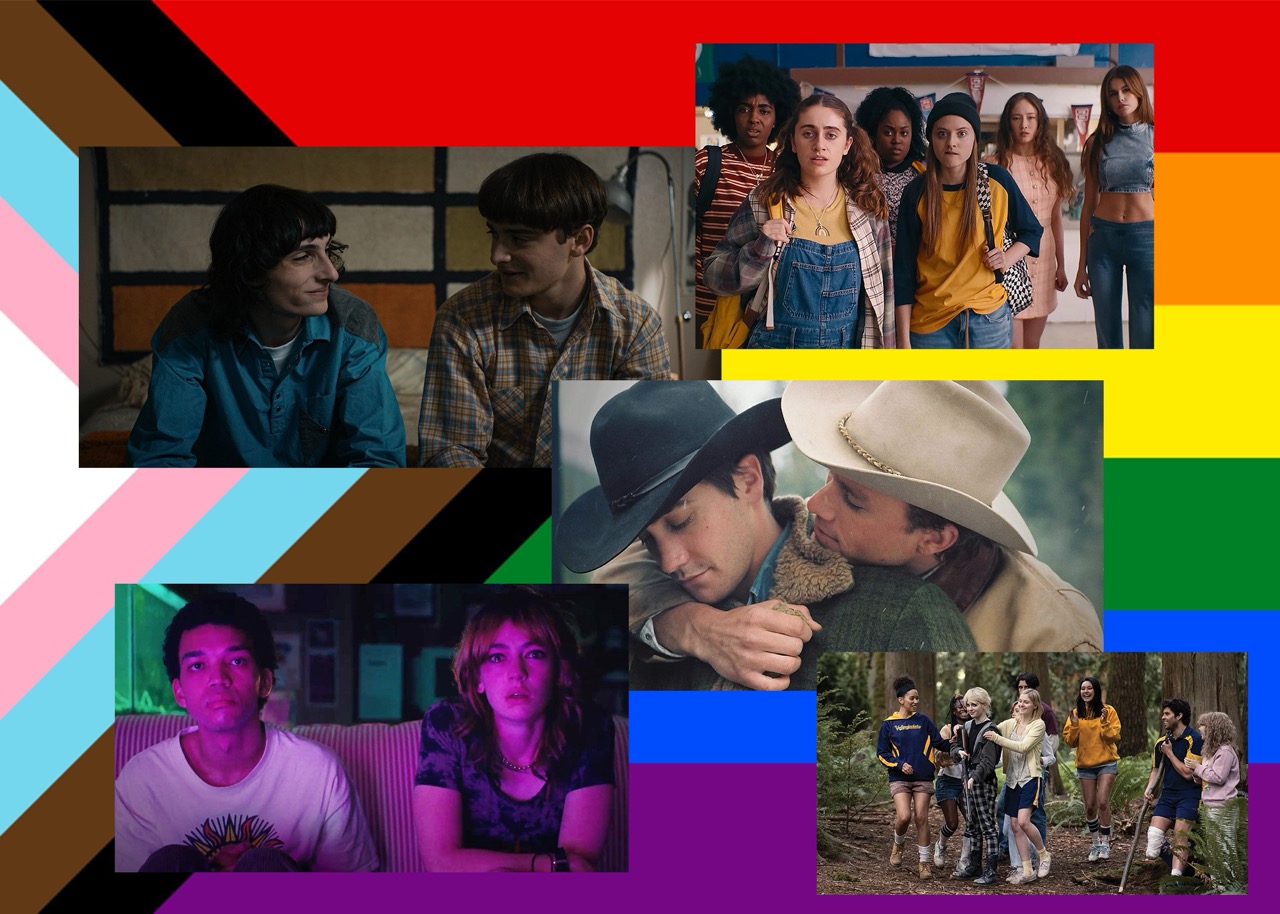
I categorize representations into two categories, symbolic and media-based, both having different key roles in how they support LGBTQ+ youth and increase social acceptance for queer identities. Symbolic representation includes recognizable objects or ideas that represent a group, most significantly pride flags. Silva Neves recognizes the importance of flags in his blog, he states “The pride flag is important for the marginalized queer communities because it can represent a place of belonging” (Neves). Flags offer a way for queer youth to be seen and have a sense of belonging within a community by knowing they are in a safe space. This is especially important for kids who could still be searching for a place to belong, giving them a sense of hope and preventing loneliness or helplessness. Symbolic representation is not just limited to flags; it includes things like painted crosswalks or doors, rainbow stickers in a window, changing branding during pride month, and more. Symbolic representation offers a wordless but loud way to show support for queer identities, especially youth who may be struggling to fit in. Equally important, media-based representation includes any inclusion of a queer identity within publicized media such as TV shows, Movies, books, and more. In a 2015 study, Bradley Bond and Benjamin Compton found a significant correlation between gay TV exposure and endorsement of gay equality (Bond). Gay and queer identities being represented in media and create a shift in social expectations and break down stigmas over time. This makes sense as including different identities in popular media will help normalize them in society and help people to rethink their thought process surrounding queer people. This is vital for youth, as growing up with less bias, stereotypes, and prejudice will let people grow up with stronger self-esteem and allow individuals to be unique and true to themselves.
Representation helps queer youth feel empowered and seen within the current society that may not fully accept them yet. It supports in many forms from helping youth feel seen and create a sense of visibility and safety, to slowly sifting the macro social stance on queer identities to be more accepting and equal. Losing these types of representation is detrimental to youth’s mental health as society moves backwards on acceptance and kids don’t feel secure in their identity. Moving forward, protecting LGBTQ+ representation is an active choice communities need to make to foster healthier futures for youth and society.
Works Cited
Written & Research Sources
Bond, Bradley J., and Benjamin L. Compton. “Gay On-Screen: The Relationship Between Exposure to Gay Characters on Television and Heterosexual Audiences’ Endorsement of Gay Equality.” Journal of Broadcasting & Electronic Media, vol. 59, no. 4, 2015, pp. 717–32, https://doi.org/10.1080/08838151.2015.1093485.
Garey, Juliann. “Mental Health Challenges of LGBTQ+ Kids: A Look at Risk Factors and Protective Factors.” Child Mind Institute, 27 May 2025, childmind.org/article/mental-health-challenges-of-lgbtq-kids/.
Neves, Silva. “Understanding and Celebrating Pride Flags.” Talking Sex and Relationships, Psychology Today, 3 Oct. 2023, https://www.psychologytoday.com/us/blog/talking-sex-and-relationships/202310/understanding-and-celebrating-pride-flags.
Photos & Screenshots
Baker, Bethany. Protesters opposing HB257 gather at the Utah Capitol during the 2024 legislative session. The Salt Lake Tribune, 1 Mar. 2024, www.sltrib.com/news/politics/2024/03/01/republicans-try-banning-pride/.
Bowmer, Rick. City buildings in Salt Lake City displaying Pride flags during Pride Month. NBC News, n.d., www.nbcnews.com/nbc-out/out-news/utah-bans-lgbtq-pride-flags-on-government-buildings-rcna198716.
Bowmer, Rick. People march following a Pride rally at the Utah Capitol in June 2023 in Salt Lake City. The Washington Post, 2 Apr. 2025, www.washingtonpost.com/nation/2025/04/02/pride-flag-bans-state-government-buildings/.
Estrella, Alfredo. Crowd displaying a rainbow banner during the Pride parade in Mexico City. National Geographic, n.d., www.nationalgeographic.com/history/article/history-of-the-lgbtqia-pride-flag.
Rainbow flags on display at Rockefeller Center’s Lower Plaza in June 2023. Yello Politics, screenshot via NBC Now, n.d., www.yellopolitics.com/p/ask-not-for-whom-the-progress-pride.
Brokeback Mountain. Directed by Ang Lee, performances by Heath Ledger and Jake Gyllenhaal, Focus Features, 2005.
Bottoms. Directed by Emma Seligman, performances by Rachel Sennott and Ayo Edebiri, Orion Pictures, 2023.
I Saw the TV Glow. Directed by Jane Schoenbrun, performances by Justice Smith and Brigette Lundy-Paine, A24, 2024.
Stranger Things. Created by the Duffer Brothers, performances by Finn Wolfhard and Noah Schnapp, Netflix, 2016–present.
Yellowjackets. Created by Ashley Lyle and Bart Nickerson, Showtime, 2021–present.
Artist Statement
LGBTQ+ representation is a topic that I care a lot about, and I wanted this project to reflect that. I think it is a key part in the developmental process of kids that is underappreciated and overlooked when discussing the causes of mental health issues for queer youth. This page is addressed to a general academic audience, but also people who may be skeptical of the effects of queer representation, in hopes to shift their mindset. I chose to create a graph, write a short essay, and create a collage to form a three-part argument for why representation matters. The website itself incorporates visual elements that help tie everything together and make a cohesive project. I programmed the website myself using HTML, JavaScript, and CSS; I’ve attached the advocacy page to the rest of my personal website as a project. By programming the website myself, I was able to include my personal favorite element of the project, having the design of the website change as the user scrolls. I added this visual element to contrast the black and white image on the top of the page with a colorful, vibrant bottom. This visually creates a difference between a site devoid of color and full of it, representing the juxtaposition of a lack of representation and an abundance of it after reading through the page.
Each of the elements on the page focus on a specific goal to work together and bring awareness. For the chart, I composed it with the goal to bring awareness specifically to what mental health issues LGBTQ+ youth face and the largest grievances they must face. I specifically chose gray and a low saturated blue to match the tone and seriousness of the data. At this point on the page, the rainbow border and menu show little to none through the gray overlay. However, when you scroll down further to the essay portion, the rainbow border shows through slightly. I chose an essay with the goal to dive deeper into the specifics on how representation matters and benefits the mental health and wellbeing of queer youth as well as to build credibility by grounding the argument in academic research. In my research I found a very useful and interesting study on how exposure to gay characters in TV has a significant impact in the endorsement of gay marriage. This was an impactful find to prove how important representation is and how impactful it can be. Scrolling further down to my collages (Switchable by using the arrows on the left and right of the collage), the page has now completely transformed into a vibrant and colorful display. I chose to make two collages, one for each type of representation I mentioned above in the essay. The first collage comprises both photos I took myself on campus, in my hometown, and photos from articles online. The second collage is a few examples of representation in media of popular TV shows and movies. I wanted to include this with the goal of showing good examples of representation and how it can be intertwined with society and the media. Overall, the website is a mixture of visual elements and detailed information to prove the influence of representation on the mental health of queer youth, and why it must be protected.